
Fitbit Air Review: The Ultimate Screenless Health Tracker
Discover how the screenless Fitbit Air redefines health tracking with its ultra-lightweight design, deep Google Health integration, and Gemini-powered sleep insights.

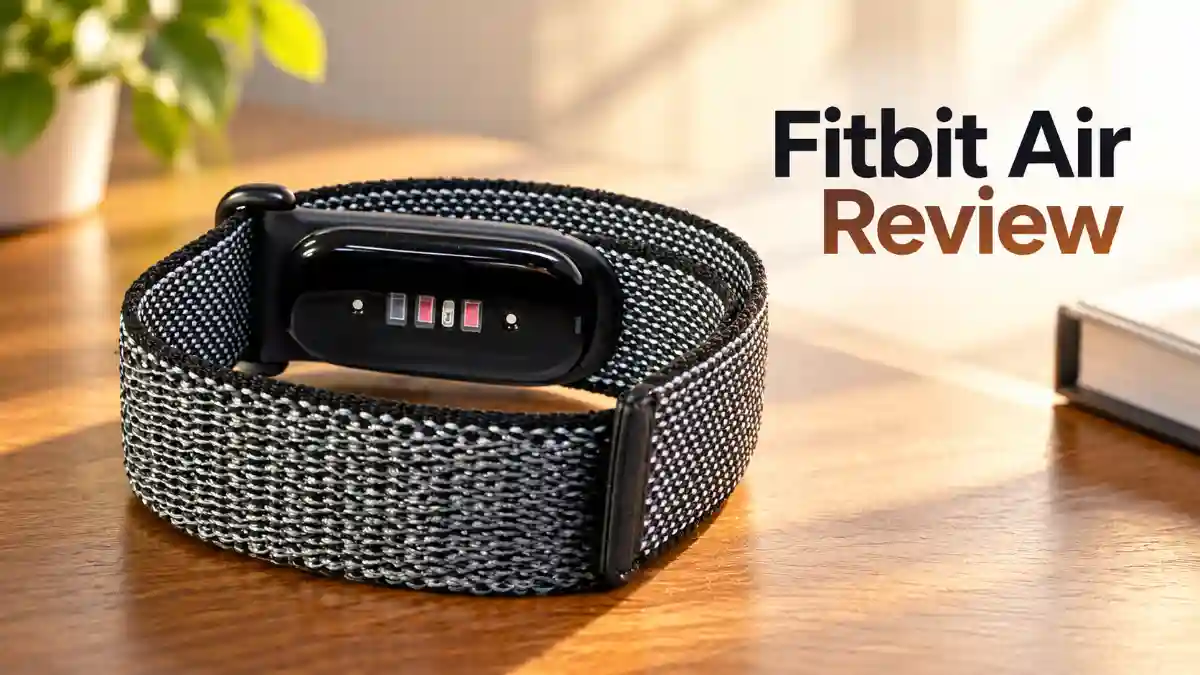
The wearable technology landscape has spent the better part of the last decade trying to put a smartphone on your wrist. We have seen displays grow larger, notifications become more intrusive, and feature sets expand to include everything from taking phone calls to scrolling through micro-apps. But somewhere along this journey, the original purpose of fitness trackers—quiet, continuous health monitoring—got lost in a sea of OLED screens and constant vibrations.
Enter the Fitbit Air, a device that boldly challenges the modern smartwatch paradigm by stripping away the screen entirely. Now operating under the Google umbrella, Fitbit has returned to its roots with a tracker designed to be felt rather than seen. It aims to collect essential health metrics silently in the background, freeing users from the digital fatigue of yet another glowing rectangle demanding their attention.
Priced at ₹13,999 in India, the Fitbit Air is not trying to compete with full-fledged smartwatches like the Pixel Watch or the Apple Watch. Instead, it carves out a niche for individuals who prioritize undisturbed focus, detailed sleep insights, and all-day physical comfort over instant messaging replies. After spending considerable time testing this minimalist companion, it is clear that going back to basics might just be the smartest move Google could have made for the fitness enthusiast.
Key Highlights: Fitbit Air at a Glance
- Design Philosophy: 100% screenless, pebble-shaped sensor module weighing just 5.2 grams.
- Comfort & Wearability: Woven fabric strap designed for 24/7 wear, including overnight sleep tracking.
- Durability: Water-resistant up to 50 meters, perfect for swimming and intense workouts.
- Smart Software: Deep integration with the Google Health app and Gemini-powered AI coaching.
- Battery Endurance: Up to 7 days of continuous use on a single charge with fast charging support.
- Pricing: ₹13,999 (Includes a three-month trial of Google Health Premium).
A Refreshingly Minimalist Approach to Design
When you unbox the Fitbit Air, the immediate takeaway is its sheer physical insignificance—and I mean that as the highest compliment. The core tracking module is incredibly tiny, tipping the scales at a mere 5.2 grams. Even when placed inside its woven fabric strap, the entire setup weighs roughly 12 grams. It looks less like a piece of cutting-edge technology and more like a simple, stylish wristband.
Because there is no display to protect or physical buttons to press, the tracker maintains a beautifully clean aesthetic. Communication is handled purely through a tiny status LED and a gentle vibration motor. A firm double-tap on the module wakes the LED: white indicates a healthy battery level, while red quietly reminds you that a charge is needed soon. The vibrations are subtle, perfectly tuned for silent morning alarms or gentle movement reminders without startling you.
Comfort is perhaps the most critical metric for any device meant to track health around the clock, and the Fitbit Air excels here. The woven fabric band breathes well and sits softly against the skin, avoiding the sweaty, sticky feeling often associated with silicone bands during intense workouts. This lightweight construction is especially noticeable at night. If you have previously abandoned sleep tracking because your smartwatch felt too bulky against your pillow, the Fitbit Air completely solves that friction point.

Google Health and the Power of Gemini AI
Without a screen, the software experience on your smartphone becomes the true face of the Fitbit Air. All data collection happens invisibly, syncing seamlessly to the Google Health app. The app's dashboard is intuitively organized, breaking down complex data into digestible sections for Today, Fitness, Sleep, and Health.
What truly sets this ecosystem apart is the introduction of Google Health Coach, powered by the Gemini AI. Available through the Google Health Premium tier, this AI integration attempts to move beyond raw data presentation. Instead of simply telling you that your resting heart rate was elevated, the Gemini AI analyzes your recent activity load, your sleep quality, and your historical baselines to explain why it might be elevated, offering tailored recovery suggestions.
While the AI coaching shows immense promise, it is still evolving. Early recommendations can sometimes feel a bit generic, acting more as motivational nudges rather than highly clinical sports science advice. However, as the tracker learns your specific habits over weeks and months, the personalized insights become noticeably sharper. It is a fantastic wellness tool, though it is important to remember that it supplements, rather than replaces, professional medical guidance.
All-Day Comfort and Continuous Sleep Insights
Sleep tracking is arguably the primary reason to invest in a screenless tracker, and the Fitbit Air delivers an incredibly robust experience. Because you are not distracted by notifications before bed, the device simply goes to work the moment you drift off. It automatically detects both nighttime sleep and daytime naps with impressive accuracy.
Each morning, the Google Health app presents a detailed breakdown of your rest. It estimates the time spent in crucial sleep stages—REM, deep, and light sleep—while also highlighting periods of restlessness. Over time, these metrics feed into your overall Readiness Score, helping you decide whether you should push hard in the gym today or opt for a gentle yoga session instead.
Heart rate monitoring is equally comprehensive. The tracker logs resting heart rate and heart-rate variability (HRV) consistently. During workouts, the data is plotted on easy-to-read graphs that visualize your cardiovascular intensity. The only minor hiccup is the automatic workout recognition. While it rarely misses a session completely, it sometimes categorizes a brisk walk as a generic "activity," requiring a quick manual confirmation in the app to label it correctly.
Performance, Battery Life, and Charging Experience
Powering a bright AMOLED display is the number one drain on any wearable device. By removing the screen, the Fitbit Air reclaims a massive amount of battery life. Google advertises up to seven days of endurance on a single charge, and real-world testing aligns perfectly with these claims. You can comfortably wear this tracker from Monday morning through Sunday night without experiencing battery anxiety.
When it is finally time to top up, the charging experience is swift. A quick five-minute burst provides roughly a full day of tracking power, which is ideal if you realize the battery is low right before heading to bed. A complete 0 to 100 percent charge takes about 90 minutes. The proprietary charging cable uses pogo pins to connect securely to the sensor module, ensuring a stable connection.
Core Strengths and Areas for Growth
- Ultimate Distraction-Free Tracking: Collects vital health data without demanding your attention or buzzing with group chat notifications.
- Featherweight Comfort: The lightweight module and soft fabric band make it the most comfortable sleep tracker on the market.
- Excellent Battery Efficiency: Seven continuous days of tracking eliminates the daily charging ritual associated with traditional smartwatches.
- Deep AI Integration: Gemini-powered Google Health Coach turns raw data into actionable lifestyle adjustments.
- Room for Refinement: Automatic workout recognition can occasionally be overly sensitive, requiring manual app adjustments.
- Subscription Dependency: While core features are free, the deepest AI insights require the ₹499/month Premium subscription after the initial trial.
The Bottom Line
The Fitbit Air is a bold step backward in order to move health tracking forward. In a tech landscape obsessed with doing everything on a single device, this tracker confidently chooses to do one thing exceptionally well: monitor your health in the background. It is not for the user who wants to control smart home devices from their wrist or dictate text messages on the run. Instead, it is tailor-made for the wellness enthusiast who values pure data, uninterrupted focus, and supreme physical comfort.
At ₹13,999, you are paying a premium for intentional minimalism. The hardware feels invisible in the best way possible, and the accompanying Google Health software does the heavy lifting to make sense of your biometrics. If you are exhausted by screen fatigue but still want clinical-grade insights into your sleep and daily activity, the Fitbit Air is currently the most refined companion available.
Important Note: The Fitbit Air includes a three-month complimentary trial of Google Health Premium, which activates upon pairing the device. Core features like basic activity and sleep tracking remain fully functional without a subscription, but advanced Gemini AI coaching requires an active membership.
Frequently Asked Questions
Quick answers to common questions about this article
Q1: Does the Fitbit Air show any notifications from my phone?
Q2: Can I use the Fitbit Air for swimming?
Q3: How do I know when the battery is running low without a screen?
Q4: Do I need a Google Health Premium subscription to use the device?
Q5: Can I wear the Fitbit Air alongside my regular smartwatch?
Salik Kumar
Founder & Lead Tech Analyst. Dedicated author focusing on high-quality, well-researched, and policy-compliant digital content.
Discussion (0)
No comments yet. Be the first to share your perspective on this topic.
Join the Conversation